
Checkster Blog
Featured Article
The Art of Client Discovery: Data Collection for Consulting
Data Collection
In the world of high-level consulting, the first 30 days of an engagement often dictate the success of the next 12 months. Every consultant knows the "discovery" phase is critical, yet many firms still treat it as an informal conversation or a scattered collection of emails and notes. In 2026, where data is the primary currency of business strategy, this manual approach is no longer sustainable.
To deliver transformative results, professional services firms must move beyond the casual chat. They need a structured, digital, and automated approach to gathering information. Mastering the art of client discovery requires the right balance of human intuition and professional workflow tools. By digitizing the intake process, firms can ensure that no insight is missed and that every project starts on a foundation of hard data.
The First Impression: Digitizing the Intake
The discovery process begins the moment a prospect shows interest. If your first request for information is a messy Word document or a generic email, you are already eroding your brand’s perceived value. Using modern client intake software allows you to present a professional, branded interface from the very first touchpoint.
A seamless experience starts with client onboarding software that guides the user through the necessary steps without overwhelming them. During this phase, firms must handle sensitive administrative requirements, such as kyc compliance forms (Know Your Customer) and initial risk assessment forms. When these are integrated into your client intake software, you aren't just checking a box for compliance; you are signaling to the client that your firm is organized, secure, and ready to handle their business.
Deep Diving with Business Discovery Forms
The "discovery" part of a consulting engagement is where the real value is uncovered. This is where you identify the gaps between where a client is and where they want to be. To do this effectively at scale, consultants need a standardized client discovery questionnaire that leaves no stone unturned.
Using digital business discovery forms allows you to capture a wide range of data points, from internal team structures to historical financial performance, in a format that is immediately actionable.
Why Digital Discovery Wins
- Standardization: Every consultant in your firm uses the same client discovery questionnaire, ensuring a consistent quality of service.
- Accuracy: Digital business discovery forms can include validation rules, preventing the submission of incomplete or incorrectly formatted data.
- Efficiency: Information gathered during discovery can be automatically piped into other professional services digital forms, reducing double entry.
By leveraging a professional data collection app, your team can conduct these discovery sessions onsite or remotely, capturing insights on a mobile device and syncing them instantly to a centralized dashboard.
Setting the Stage: The Project Kickoff
Once the discovery data is in hand, the next step is the formal launch. A common pitfall in professional services is "scope creep," which almost always stems from a poorly defined kickoff.
Using consulting project kickoff forms helps define the boundaries of the engagement. These forms should clearly outline the milestones, deliverables, and key performance indicators (KPIs) identified during the discovery phase. This is also the ideal time to finalize consulting engagement letters, ensuring that legal and operational expectations are perfectly aligned.
By incorporating professional services checklists into the kickoff, you ensure that every logistical detail, from software access to meeting cadences, is handled before the "real" work begins. This is where business process automation starts to shine, as the completion of a kickoff form can trigger the creation of tasks in your project management system.
Audits and Compliance: The Digital Advantage
For many consulting firms, "discovery" is synonymous with an audit. Whether you are performing a financial, operational, or technical review, the tools you use define your accuracy. Traditional spreadsheets are prone to error and difficult to track over time.
Instead, top-tier firms utilize audit procedure software to manage complex evaluations. Using digital audit forms allows your team to perform site visits or document reviews with a higher level of precision. These forms can include:
- Photo evidence and document uploads.
- Automated scoring based on specific compliance benchmarks.
- Regulatory compliance checklists tailored to the client’s industry.
When your digital audit forms are linked to a compliance verification tool, you can provide the client with a real-time "compliance score." This level of transparency builds immense trust and positions your firm as a technology-forward leader in the space.
Streamlining Workflows with Automation
The ultimate goal of using professional services digital forms is to spend less time on administration and more time on strategy. This is achieved through business process automation.
Imagine a scenario where a client completes a client discovery questionnaire, and the system automatically:
- Generates a risk profile using a compliance verification tool.
- Populates the consulting engagement letters with the relevant data.
- Creates a customized set of project management checklists for the consulting team.
This is the power of using a unified professional data collection app. It turns data collection from a chore into a competitive advantage. These professional workflow tools allow you to scale your firm without linearly increasing your administrative staff.
Closing the Loop: Feedback and Iteration
The art of discovery doesn't end when the project starts. It is a continuous cycle of gathering information, acting on it, and refining the process. To improve your discovery methods, you must understand how your clients feel about the process.
Deploying client satisfaction surveys at the end of the discovery phase, not just at the end of the project, provides invaluable insights into your firm’s "onboarding health." Are your business discovery forms too long? Is the client onboarding software easy to navigate? By listening to this feedback, you can refine your consulting audit templates and questionnaires to be even more effective for the next client.
Why Checkster is the Best Tool for Professional Services
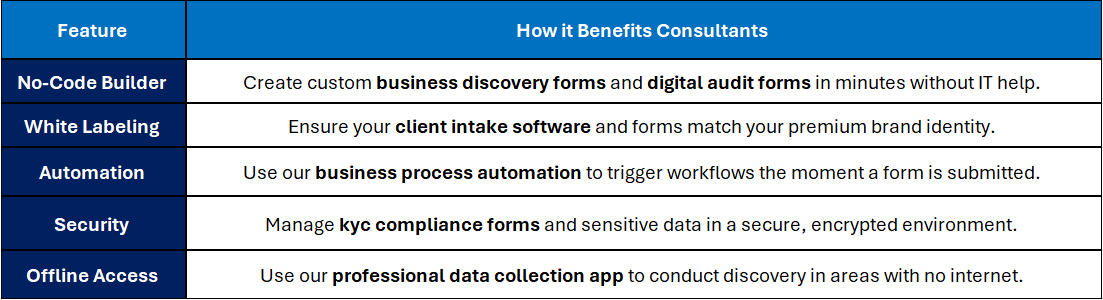
At Checkster, we’ve built a platform specifically designed to handle the rigorous demands of professional data collection. We understand that in consulting, your tools are a reflection of your expertise.
Conclusion: Data is the Foundation of Strategy
The difference between a "good" consultant and a "great" one often comes down to the quality of the information they possess. By mastering the art of the discovery through the use of business discovery forms, a comprehensive client discovery questionnaire, and robust professional workflow tools, you are setting your firm up for long-term success.
Stop relying on fragmented systems and manual data entry. Embrace the efficiency of client onboarding software and the precision of audit procedure software. When you improve your data collection, you improve your consulting outcomes. Let Checkster provide the digital foundation for your firm’s next big engagement.