
Checkster Blog
Featured Article
Measuring Event Success: Post-Event Breakdown Guide
Post-Event Breakdown Guide
The lights have dimmed, the last guest has departed, and the venue is finally quiet. For many planners, this is the moment to breathe a sigh of relief. However, in the professional world of event planning, the work doesn't end when the doors close. The period immediately following an event is arguably the most critical for growth, and it is known as the "post-event breakdown."
Historically, this phase was often neglected or handled with anecdotal evidence—vague feelings about whether the crowd "seemed happy" or if the food "looked good." In 2026, successful planners have traded gut feelings for granular data. By utilizing sophisticated event production software, organizers are now able to transform every interaction into a measurable metric.
This guide will walk you through a professional framework for a data-driven debrief, showing you how to use an event planning checklist app to ensure your next gathering is even more successful than the last.
Why the Post-Event Breakdown Matters
An event is a massive investment of time, capital, and brand reputation. Without a structured breakdown, you are essentially flying blind into your next project. A formal debrief allows you to:
- Validate ROI: Prove to stakeholders or clients that the event met its financial and strategic goals.
- Identify Operational Friction: Pinpoint exactly where the registration line slowed down or why a specific vendor underperformed.
- Refine the Attendee Profile: Understand who actually showed up versus who you expected to show up.
To do this effectively, you need to move beyond paper notes. Implementing digital event checklists ensures that the data you collect is standardized, searchable, and ready for analysis.
Phase 1: Capturing Immediate Feedback with an Onsite App
The best time to collect data is while the experience is still fresh in everyone's mind. This is where an onsite event management app becomes invaluable. Waiting until Monday morning to ask your floor staff how the VIP check-in went is a recipe for forgotten details.
By using event management digital forms, your onsite team can log incidents, successes, and observations in real-time. Whether it’s a note about a technical glitch during the keynote or a compliment on the catering, capturing this data digitally ensures it doesn't get lost in the post-event "brain fog."
The Staff Debrief
Before the team leaves the venue, have them complete quick post-event breakdown forms. This shouldn't be a long essay; it should be a structured set of questions designed to capture:
- Immediate Wins: What went better than expected?
- Critical Fails: What needs an immediate fix before the next session?
- Vendor Performance: Did the AV team meet the requirements outlined in the event vendor contract forms?
Phase 2: Quantifying the Attendee Experience
The heart of your event is the person who attended it. To measure success, you need to look at both their behavior and their sentiment.
Analyzing Attendee Management Forms
Your attendee management forms are more than just a list of names. When integrated with your event production software, this data tells a story. Look for:
- Drop-off Rates: Did people register but not show up?
- Session Popularity: Which workshops had the highest attendance?
- Engagement Levels: How many people completed their full profile or interacted with sponsors?
The Power of Event Feedback Surveys
Once the event is over, sending out event feedback surveys is standard practice. However, the key is in the timing and the structure. Using an event planning checklist app to schedule these surveys ensures they hit inboxes while the excitement is still high.
Avoid generic questions. Instead, use your digital event checklists to ensure you are asking about specific touchpoints: the ease of registration, the quality of the speakers, and the value of the networking opportunities.
Phase 3: The Operational and Financial Audit
A successful event must also be a financially viable one. This is where the "back-office" data comes into play.
Budget and Timeline Reconciliation
One of the most overlooked aspects of the breakdown is comparing the "plan" to the "reality." Using an event budget tracking forms system allows you to see exactly where you overspent and where you saved.
- Did the decorations cost 20% more than the initial quote?
- Were there hidden labor costs that weren't caught in the conference planning digital tools?
Similarly, use an event timeline tracking tool to review the "run of show." If the lunch break consistently ran 15 minutes late, you know to adjust the schedule for next year. These insights are essential for maintaining a professional reputation and ensuring long-term profitability.
Vendor and Volunteer Management
Reviewing your volunteer signup forms can help you understand your staffing needs for future events. Did you have too many people at the info desk and not enough at the entrance? By analyzing the data from your event management digital forms, you can optimize your labor force for the next project.
Comparison: Manual vs. Digital Post-Event Data
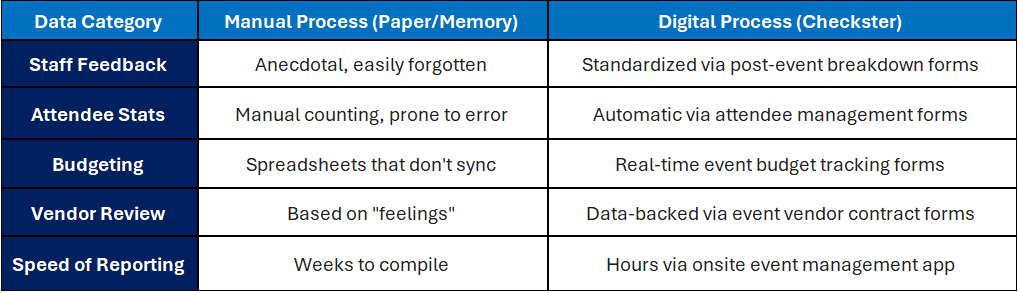
Why Checkster is the Ultimate Event Partner
At Checkster, we know that event planners are constantly on the move. You don't have time for clunky, complex software that requires a degree in IT to operate. Our platform provides the flexibility of conference planning digital tools with the simplicity of a no-code interface.
- Mobile-Ready: Our onsite event management app works on any device, allowing your team to log data from the showroom floor or the backstage area.
- Customizable Forms: Easily build everything from volunteer signup forms to complex event feedback surveys using our drag-and-drop builder.
- Data Integrity: Ensure your post-event breakdown forms are complete and accurate with mandatory fields and photo uploads.
- Automated Logic: Use an event planning checklist app that triggers specific tasks based on form responses—like notifying a manager if a vendor receives a "poor" rating.
Conclusion: Turning Data into Your Next Sold-Out Event
The post-event breakdown is not just a look back; it is the first step toward your next success. By moving away from fragmented notes and embracing a unified system of event management digital forms and event production software, you are building an institutional memory that grows with every project.
When you can prove your success with data, you build trust with sponsors, delight your clients, and create a better experience for your attendees. It is time to stop guessing and start measuring. Let the digital event checklists of today be the blueprint for your sold-out conference tomorrow.