
Checkster Blog
Featured Article
Case Study: Automating Factory Safety & Productivity
Factory Safety & Productivity
In the world of high-volume manufacturing, the hum of the machinery is the sound of success. But for one mid-sized automotive parts manufacturer we recently worked with, that hum was often interrupted by the frantic rustle of paper. For years, their safety culture lived in three ring binders and overstuffed filing cabinets. If you wanted to see the latest industrial safety forms, you had to hope the floor manager hadn't left them on a forklift or spilled coffee on the signature line.
The problem wasn't a lack of effort; it was a lack of infrastructure. Like many legacy operations, they relied on manual shop floor data collection to track everything from incident reports to machine health. The result? A disconnected operation where data was always 24 hours behind reality, and equipment downtime logs were filled out retrospectively, often based on memory rather than fact.
By partnering with Checkster, this facility transformed its chaotic paper trail into a streamlined, digital powerhouse. Here is the story of how they traded their clipboards for tablets and redefined their productivity.
The Breaking Point: The Cost of Paper, Based Operations
Before the transition, the plant faced a recurring nightmare: the internal audit. Whenever it was time for manufacturing compliance tracking, the administrative team would spend days reconciling handwritten notes with digital spreadsheets. Because they lacked a centralized manufacturing inspection software, there was no "single source of truth."
The "pencil, whipping" effect was also a major concern. Without the validation provided by manufacturing digital forms, it was easy for busy operators to check boxes on industrial safety forms without actually performing the check. This wasn't due to negligence, but rather the friction of the process. When a tool is hard to use, people find shortcuts.
The plant manager realized they needed a change when a critical piece of equipment failed, causing a six-hour stoppage. The equipment downtime logs revealed that the warning signs had been noted on a paper report three days earlier, but that report was still sitting in an inbox waiting to be typed up.
The Solution: A Digital Revolution with Checkster
The facility chose to implement Checkster's manufacturing inspection software to bridge the gap between the shop floor and the management office. The goal was simple: make data entry so easy that it became a natural part of the workflow, and make that data immediately actionable.
1. Digitizing the Foundation
The first step was converting their legacy paperwork into manufacturing digital forms. This wasn't just a 1:1 copy; it was an optimization. By using a no-code factory audit software, the team built smart industrial safety forms that required photo evidence for specific high-risk checks. If a safety guard wasn't properly in place, the operator had to take a photo, which immediately triggered an alert in the manufacturing workflow automation system.
2. Standardizing Quality and Maintenance
The quality department implemented digital quality control (QC) checklists that were integrated directly into the production line. Using a mobile production line inspection tool, inspectors could now log defects in real time. This shop floor data collection provided an instant heat map of where errors were occurring, allowing the engineering team to adjust the machines mid-shift, rather than waiting for the end of week production quality reports.
To handle the machinery, the facility deployed an equipment maintenance app. Technicians moved their machine inspection logs to tablets, allowing them to access the full service history of any asset simply by scanning a QR code. This shift to an equipment maintenance app meant that preventive maintenance checklists were no longer "suggestions"; they were mandatory, time-stamped digital tasks.
The Results: Data-Driven Productivity
The transition didn't just save paper; it saved time and money. Within six months of using the manufacturing inspection software, the facility reported a 22% reduction in unplanned maintenance events.
Real-Time Visibility
The leadership team no longer had to wait for meetings to understand the state of the plant. They could pull up production quality reports on their dashboards at any moment. The shop floor data collection was now live, meaning that if quality control (QC) checklists started showing a trend of "out of spec" parts, the line could be paused before thousands of dollars in scrap were created.
Audit Readiness
With the implementation of factory audit software, the facility became "perpetually audit-ready." When it came time for their ISO certification renewal, they didn't scramble. They simply exported their ISO audit digital forms and manufacturing compliance tracking logs. The auditor was impressed by the transparency of the machine inspection logs and the verifiable nature of the industrial safety forms.
Streamlined Workflows
By using manufacturing workflow automation, the "lag time" between identifying a problem and fixing it was virtually eliminated. A failed check on the assembly line checklists would automatically generate a ticket in the equipment maintenance app. This closed-loop system ensured that equipment downtime logs became a tool for improvement rather than just a record of failure.
Breaking Down the Digital Impact
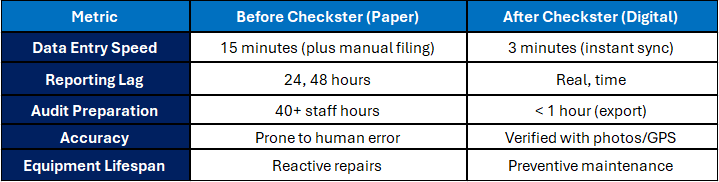
Overcoming the "Tech Fear" on the Floor
One of the biggest hurdles in manufacturing is the adoption of new technology by veteran staff. The facility manager was worried that moving away from paper would be met with resistance. However, because the production line inspection tool was designed for the field, the learning curve was nearly flat.
The staff found that using a tablet was actually faster than hunting for a pen and a clean piece of paper. The use of assembly line checklists on a tablet allowed them to focus on the work rather than the paperwork. Furthermore, because the industrial site audit app worked offline, operators in shielded areas of the plant never lost their progress. You can find more about how our tools handle connectivity in our FAQ.
Why Every Modern Factory Needs a Digital Spine
This case study proves that productivity isn't just about how fast you can build; it's about how well you can manage the data behind the build. When you replace manual shop floor data collection with a professional production line inspection tool, you remove the "blind spots" in your operation.
The benefits of factory audit software extend beyond the factory walls. It builds trust with clients, ensures the safety of the workforce through better industrial safety forms, and provides the production quality reports needed to scale the business.
If you are ready to see how your facility can move from clipboards to tablets, we invite you to explore our pricing to find a plan that fits your scale. Checkster is more than just a digital checklist; it is a manufacturing inspection software designed to turn your data into your greatest asset.
Conclusion: The Future of Manufacturing is Paperless
The factory in our case study no longer fears the audit or the unexpected breakdown. By embracing manufacturing digital forms and manufacturing workflow automation, they have reclaimed hours of their day and thousands of dollars in their budget.
Whether you need to tighten your quality control (QC) checklists, manage your preventive maintenance checklists, or simply digitize your ISO audit digital forms, the path forward is clear. Stop letting paper slow down your machines. Let Checkster provide the digital foundation for your next era of growth.
Start your own digital transformation.
Contact us today to schedule a demo and see how our industrial site audit app and equipment maintenance app can revolutionize your productivity.